<?xml version="1.0" encoding="UTF-8"?>
<!--Generated by Squarespace Site Server v5.11.81 (http://www.squarespace.com/) on Thu, 31 May 2012 06:05:47 GMT--><feed xmlns="http://www.w3.org/2005/Atom" xmlns:dc="http://purl.org/dc/elements/1.1/"><title>Blog</title><subtitle>Blog</subtitle><id>http://www.designinvestigations.com/blog/</id><link rel="alternate" type="application/xhtml+xml" href="http://www.designinvestigations.com/blog/"/><link rel="self" type="application/atom+xml" href="http://www.designinvestigations.com/blog/atom.xml"/><updated>2011-12-31T20:04:00Z</updated><generator uri="http://www.squarespace.com/" version="Squarespace Site Server v5.11.81 (http://www.squarespace.com/)">Squarespace</generator><entry><title>Eva Zeisel, 11/13/1906 - 12/30/2011</title><category term="Eva Zeisel"/><id>http://www.designinvestigations.com/blog/2011/12/30/eva-zeisel-11131906-12302011.html</id><link rel="alternate" type="text/html" href="http://www.designinvestigations.com/blog/2011/12/30/eva-zeisel-11131906-12302011.html"/><author><name>Katherine Bennett</name></author><published>2011-12-31T05:14:03Z</published><updated>2011-12-31T05:14:03Z</updated><content type="html" xml:lang="en-US"><![CDATA[<p><a href="http://en.wikipedia.org/wiki/Eva_Zeisel">Eva Zeisel</a>,&nbsp;the last of the 20th Century masters, passed away peacefully today. She arose, showered and dressed, sat in her chair, and soon afterward left us, I would like to think, to pursue her "playful search for beauty" in the great beyond.</p>
<p><span class="full-image-block ssNonEditable"><span><img style="width: 500px;" src="http://www.designinvestigations.com/storage/Century57.jpg?__SQUARESPACE_CACHEVERSION=1325308661184" alt="" /></span></span></p>
<p>At Eva's 90th birthday, James Fulton, her student (Pratt 1951) and a major figure himself in industrial design, said that Eva "moved through all the modern movements yet was moved by none of them." She defied convention. During the sterile and, as Eva said, "anorexic" years when Modernist dogma commanded us to "reduce, reduce, reduce" designs to their simplest Euclidean form, she reveled in curves, color, and, yes, ornament. She said to me once that young designers will ornament their bodies with piercings or tattoos, yet it would be forbidden for them to add those ornaments to their designs. "The vase with the flower on it will never get the award. The student who presents in in class will get an F."&nbsp;&nbsp;</p>
<p><span class="full-image-block ssNonEditable"><span><img style="width: 500px;" src="http://www.designinvestigations.com/storage/Composite-sm.jpg?__SQUARESPACE_CACHEVERSION=1325308886655" alt="" /></span></span></p>
<p>She mentored generations of designers, from her students at Pratt from 1939 to 1954, to young designers in the present, teaching us all that the playful search for beauty is in itself a noble goal.&nbsp;</p>
<p>She used the word "pretty."&nbsp;&nbsp;</p>
<p>When she leaned toward me in one of our conversations and said, "We are makers of pretty things," I recoiled as if struck. I come from the generation of industrial designers educated in the 80s, who faced some hard years in the trenches, defending our expertise to corporate types who hadn't a clue about what it was that we actually did. We never referred to our work as "making pretty things." In our client pitches, we loaded - and still load - our language with B-School grenades like "adding value" and "impacting the bottom line," endeavoring to break through the culture barrier in the corporate conference room. We fought an uphill battle - intuitives in a world that worshiped the quantifiable.&nbsp;</p>
<p>She rejected formulaic solutions.&nbsp;</p>
<p>In the 50s and 60s, the Museum of Modern Art endeavored to teach Americans what "good design" was. Zeisel was on one of their expert panels and refused to answer the question, "What is Good Design?" She refused to ordinate one design as "good-er" than another.&nbsp;</p>
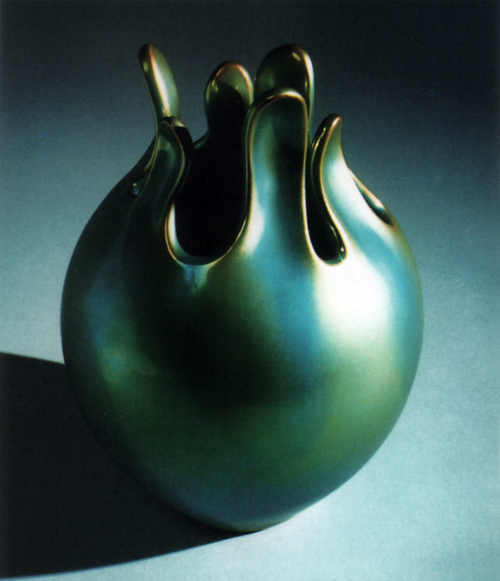
<p>This does not mean that she settled for less than perfect. Comparing her work to others in her millieu, she made most look like slouches. Her pieces show a sure-footedness of line that knows exactly how a curve will start, where it will go, and how it will end.&nbsp;&nbsp;</p>
<p><span class="full-image-block ssNonEditable"><span><img style="width: 500px;" src="http://www.designinvestigations.com/storage/FigVaseSm.jpg?__SQUARESPACE_CACHEVERSION=1325309873737" alt="" /></span></span></p>
<p>If you are lucky enough to see one of her designs in the flesh, and if you are even luckier to be able to put your hands on it, there is a visceral jolt at the touch, the feel of it. Just the other day I received in the mail one of her Town and Country casseroles. I had never held one. As I laid my hand on the handle, the sensation of that shape in my palm was electrifying. Her designs reward the hand.&nbsp;</p>
<p><span class="full-image-block ssNonEditable"><span><img src="http://www.designinvestigations.com/storage/TC1.jpg?__SQUARESPACE_CACHEVERSION=1325309830044" alt="" /></span></span></p>
<p>She was a master of masters.&nbsp;&nbsp;</p>
<p>She created designs that were lauded by the design cognoscenti and also loved by ordinary people. She traveled the world and said that encountering her designs on kitchen tables from Kansas to Krakow was like seeing "so many well-behaved grandchildren."</p>
<p><span class="full-image-block ssNonEditable"><span><img src="http://www.designinvestigations.com/storage/Prestige Glassware.psd?__SQUARESPACE_CACHEVERSION=1325309750131" alt="" /></span></span>&nbsp;</p>
<p>These days, we talk alot about expressing emotion with our designs. One of the most important lessons I learned from Eva was that to her, design was not driven by a self-serving need to express herself; it was an act of generosity, giving a gift. She spoke of "making soul contact" with her public, in very much as the same way as Charles Eames' "guest-host relationship," where the designer is the gracious host.</p>
<p>My teachers were Modernists. Their teachers were Modernists. Their teachers teachers were Modernists. Under the 70-year thrall of Rationalism, the knowledge of how to sculpt curvilinear form, not to mention how to use color and apply ornament, was lost to us. As we strive to break the code today, Eva has much to teach us.</p>
<p><span class="full-image-block ssNonEditable"><span><img src="http://www.designinvestigations.com/storage/Eva%20w-Town%20%20Country.psd?__SQUARESPACE_CACHEVERSION=1325309361968" alt="" /></span></span></p>
<p>She was one of the keepers of the lost art. May she rest in peace.</p>
<p>William L. Hamilton's <a href="http://www.nytimes.com/2011/12/31/arts/design/eva-zeisel-ceramic-artist-and-designer-dies-at-105.html?pagewanted=1&amp;_r=1&amp;ref=obituaries">New York Times obit</a> was published December 30, 2011, on page B7.</p>]]></content></entry><entry><title>The Architect and the Painter</title><category term="Deborah Sussman"/><category term="Eames"/><category term="Paul Prejza"/><id>http://www.designinvestigations.com/blog/2011/12/3/the-architect-and-the-painter.html</id><link rel="alternate" type="text/html" href="http://www.designinvestigations.com/blog/2011/12/3/the-architect-and-the-painter.html"/><author><name>Katherine Bennett</name></author><published>2011-12-03T21:55:25Z</published><updated>2011-12-03T21:55:25Z</updated><content type="html" xml:lang="en-US"><![CDATA[<p><iframe width="560" height="315" src="http://www.youtube.com/embed/zJDkGsOnoDU" frameborder="0" allowfullscreen></iframe></p>
<div></div>
<div></div>
<div id="_mcePaste"></div>
<div id="_mcePaste">Went to see the new documentary about the Eameses this morning and was very glad to have caught it. The story of the Office of Charles and Ray Eames is fascinating and complex. Over the years I've been learning it, a piece at a time. This latest film is, on its surface, about the partnership between Charles and Ray, but it paints as complete a picture as I've yet seen about the office and the work that took place there.</div>
<div></div>
<div></div>
<div id="_mcePaste"></div>
<div id="_mcePaste">In my History of ID course at Art Center I take at least one evening, if not two, covering the office, because knowing how this work took place is an essential component to any designer's education. The Eames Office was and still is the ultimate model of a life spent in service to the glorious act of design.</div>
<div></div>
<div></div>
<div id="_mcePaste"></div>
<div id="_mcePaste">At the screening I was lucky enough to run into <a href="http://www.sussmanprejza.com/">Deborah Sussman and Paul Prejza</a> and we had a lovely chat about the film. Deborah told me about an <a href="http://aigalosangeles.org/events/2011/12/in-conversation-deborah-sussma.php">upcoming AIGA event</a> at the A+D Museum across from LACMA, where she and the designer Andrew Byrom will talk about her work and their collaboration on the current exhibition at the A+D, <a href="http://www.aplusd.org/exhibitions-current">Eames Words</a>.</div>
<div></div>
<div></div>
<div>
<div></div>
</div>
<div><span class="full-image-block ssNonEditable"><span class="full-image-block ssNonEditable"><span><img style="width: 500px;" src="http://www.designinvestigations.com/storage/Pasted%20Graphic.tiff?__SQUARESPACE_CACHEVERSION=1322950604886" alt="" /></span></span><br /></span></div>
<div></div>
<div>The event will be Thursday, December 8th, 6:30 - 8:30 and sounds promising. I have not seen the exhibit yet, and so I plan to go Thursday, if not sooner (I'm taking a group of students to see California Design at LACMA this Tuesday, so I might take the opportunity to visit the A+D then).</div>
<div></div>
<div id="_mcePaste"></div>
<div id="_mcePaste">I can never get enough of this story. The Eames Office taught us how it is done, and there is always more of this lesson to learn. I don't know how long this film will be showing - if I were you, I'd catch it while you can.</div>]]></content></entry><entry><title>Urbanized</title><category term="Enrique Peñalosa"/><category term="Gary Hustwit"/><category term="Urbanized"/><category term="urbanism"/><id>http://www.designinvestigations.com/blog/2011/9/26/urbanized.html</id><link rel="alternate" type="text/html" href="http://www.designinvestigations.com/blog/2011/9/26/urbanized.html"/><author><name>Katherine Bennett</name></author><published>2011-09-26T20:26:41Z</published><updated>2011-09-26T20:26:41Z</updated><content type="html" xml:lang="en-US"><![CDATA[<p><iframe width="560" height="315" src="http://www.youtube.com/embed/6jpN8kI0-pY" frameborder="0" allowfullscreen></iframe></p>
<p>My brother <a href="http://www.wfb4.com/">Bill</a> and I went to the screening of Gary Hustwit's new documentary, <a href="http://urbanizedfilm.com/">Urbanized</a>, last night. This is the third in his series on design that includes Helvetica and Objectified. Like Objectified, I suspect that for designers in the discipline, in this case architects and urban designers, there was no new knowledge here, but we found it fascinating. I had known about a number of the people and events included in the documentary, but some parts were new to me.&nbsp;</p>
<p>Especially interesting was the ongoing history of urban development and the implications of development with and without the participation of the residents. The day Hustwit's team arrived in Stuttgart they got caught up in the violent police action against protestors of the <a href="http://www.spiegel.de/international/germany/0,1518,720807,00.html">Stuttgart 21 project</a>.</p>
<p>In Hustwit's interviews, project developers maintained that the public was consulted, but the vehemence of the protest belies that. In fact, the long-dominant political party that backed the project was ousted soon afterward, replaced by the Green Party - a first. In the meantime, the work on the project continues.</p>
<p>This of course reminds us of New Yorkers' futile protests to stop the Cross-Bronx expressway in the late 40s. it took the destruction of Penn Station in 1963 to enlist enough protest to put a stop to Robert Moses' next project - an expressway across Greenwich Village. Jane Jacobs wrote <a href="http://en.wikipedia.org/wiki/The_Death_and_Life_of_Great_American_Cities">her book</a>, and a new age of architectural preservation and Urbanism was born.</p>
<p>One of my favorite segments was on artist &amp; designer Candy Chang's <a href="http://candychang.com/i-wish-this-was/">"I Wish This Was"</a> project. She put stickers on vacant storefronts in her home town, New Orleans, and invited people to write on them.</p>
<p><span class="full-image-block ssNonEditable"><span><img style="width: 560px;" src="http://www.designinvestigations.com/storage/i-wish-this-grid-bur.jpg?__SQUARESPACE_CACHEVERSION=1317069769634" alt="" /></span></span></p>
<p><span class="full-image-block ssNonEditable"><span><img src="http://www.designinvestigations.com/storage/i-wish-this-was-a-place-to-sit-and-talk.jpg?__SQUARESPACE_CACHEVERSION=1317070385276" alt="" /></span></span></p>
<p><span class="full-image-block ssNonEditable"><span><img src="http://www.designinvestigations.com/storage/i-wish-this-was-owned-by-someone-who-cared.jpg?__SQUARESPACE_CACHEVERSION=1317069851651" alt="" /></span></span></p>
<p><span class="full-image-block ssNonEditable"><span><img src="http://www.designinvestigations.com/storage/i-wish-this-was-brad-pitts-house.jpg?__SQUARESPACE_CACHEVERSION=1317070118433" alt="" /></span></span></p>
<p>My brother commented that <a href="http://www.downtownindependent.com/">the theater</a> had a very good projector, something we find important here in LA, and also complemented the cinematographer, Luke <span>Geissb&uuml;hler</span>, and his exquisite and careful framing of the shots.</p>
<p>Both of us liked the segment on former Bogot&aacute; Mayor Enrique Pe&ntilde;alosa. I was familiar with him from <a href="http://www.pbs.org/e2/episodes/209_bogota_building_sustainable_city_trailer.html">the PBS series E2</a>, but enjoyed seeing him again as he toured the city on his bicycle, pointing out the sustainable and civic-minded improvements he made to the city. He developed a number of projects, including parks, libraries, and one of the most extensive bike path networks in the world.&nbsp; Pe&ntilde;alosa is an extremely engaging critic of our modern urban landscape, questioning the status quo and poking a finger in the eye of the establishment where he sees the need, as in <a href="http://www.nytimes.com/2008/06/08/magazine/08WWLN-Q4-t.html">his comparison of the estates overlooking Long Island Sound with corrupt pre-revolution French aristocracy</a>. He is not afraid to go up against incumbent power, as he did with the TransMilenio, a rapid transit system that replaced a chaotic system of privately-run and competing busses.</p>
<p>He was almost impeached for eliminating parking in Bogot&aacute;, and he considers himself a "bad politician," because he keeps losing elections. Though he lost his bid for Mayor again in 2007, Hustwit says he's planning another run. We're wondering if we'd be allowed to vote.</p>]]></content></entry><entry><title>A Dangerous Idea</title><category term="ben mcallister"/><category term="bolt | peters"/><category term="design research"/><category term="frogdesign"/><category term="nate bolt"/><id>http://www.designinvestigations.com/blog/2011/6/26/a-dangerous-idea.html</id><link rel="alternate" type="text/html" href="http://www.designinvestigations.com/blog/2011/6/26/a-dangerous-idea.html"/><author><name>Katherine Bennett</name></author><published>2011-06-26T19:21:54Z</published><updated>2011-06-26T19:21:54Z</updated><summary type="html" xml:lang="en-US"><![CDATA[Humans don't like uncertainty and ambiguity, so the impulse to find easy answers is a strong one. Without the uncertainty, however, there is no need for real leadership. What we're left with, McAllister says, is merely following directions. To provide true leadership, rather than easy answers, is to face the ambiguity. This is the act of courage required of the designer.]]></summary></entry><entry><title>The Mastery of Color Theory</title><category term="Art Center"/><id>http://www.designinvestigations.com/blog/2010/11/21/the-mastery-of-color-theory.html</id><link rel="alternate" type="text/html" href="http://www.designinvestigations.com/blog/2010/11/21/the-mastery-of-color-theory.html"/><author><name>Katherine Bennett</name></author><published>2010-11-22T02:44:59Z</published><updated>2010-11-22T02:44:59Z</updated><content type="html" xml:lang="en-US"><![CDATA[<p><span class="full-image-block ssNonEditable"><span><img src="http://www.designinvestigations.com/storage/Richard_Keys.jpg?__SQUARESPACE_CACHEVERSION=1306770825001" alt="" /></span></span>Mentioning Richard Keyes in the previous post reminded me of his <a href="http://www.thegnomonworkshop.com/store/product/472/Color-Theory%3A-The-Mechanics-of-Color">excellent DVD</a> on color theory. He is the keeper of the legacy in this subject, standing on the shoulders of the giants who taught at Art Center in the old days. He is elegant and precise in his teaching, and I am thrilled that <a href="http://www.drawthrough.com/">Scott Robertson</a> has added this DVD to the collection at Gnomon. I hope it's the first of a series.</p>]]></content></entry><entry><title>Formula "E" Racing</title><category term="Art Center"/><category term="Grad ID"/><id>http://www.designinvestigations.com/blog/2010/11/21/formula-e-racing.html</id><link rel="alternate" type="text/html" href="http://www.designinvestigations.com/blog/2010/11/21/formula-e-racing.html"/><author><name>Katherine Bennett</name></author><published>2010-11-21T21:21:09Z</published><updated>2010-11-21T21:21:09Z</updated><content type="html" xml:lang="en-US"><![CDATA[<div></div>
<div></div>
<div><iframe src="http://player.vimeo.com/video/17059630" width="400" height="300" frameborder="0"></iframe>
<p><a href="http://vimeo.com/17059630">Formula E, Summer 2010</a> from <a href="http://vimeo.com/user612714">Katherine Bennett</a> on <a href="http://vimeo.com">Vimeo</a>.</p>
</div>
<div>One of our regular events in Grad ID is the "Formula E" race, where the students build and race a radio-controlled car that is powered by a rubber band (the E stands for elastic). This is a fun exercise in hands-on mechanical problem solving. We make it even more interesting by asking them to create flyers and short video stories about the race. These are done in my colleague <a href="http://www.thegnomonworkshop.com/includes/interviews/rkeyes.php">Richard Keyes</a>' class and the results are sometimes quite entertaining.&nbsp;</p>
<div></div>
<div>Above is last term's crew's advertising campaign. Below is a short film created by Uri Tzarnotzky and Koo Ho Shin for the 2009 competition.&nbsp;</div>
<p>&nbsp;</p>
<div><object width="480" height="385"><param name="movie" value="http://www.youtube.com/v/uVZmMqisogM?fs=1&amp;hl=en_US"></param><param name="allowFullScreen" value="true"></param><param name="allowscriptaccess" value="always"></param><embed src="http://www.youtube.com/v/uVZmMqisogM?fs=1&amp;hl=en_US" type="application/x-shockwave-flash" allowscriptaccess="always" allowfullscreen="true" width="480" height="385"></embed></object></div>]]></content></entry><entry><title>Engines of Innovation</title><category term="Brian Eno"/><category term="Steven Johnson"/><category term="creativity"/><category term="innovation"/><id>http://www.designinvestigations.com/blog/2010/3/6/engines-of-innovation.html</id><link rel="alternate" type="text/html" href="http://www.designinvestigations.com/blog/2010/3/6/engines-of-innovation.html"/><author><name>Katherine Bennett</name></author><published>2010-03-06T20:55:00Z</published><updated>2010-03-06T20:55:00Z</updated><content type="html" xml:lang="en-US"><![CDATA[<p><a onblur="try {parent.deselectBloggerImageGracefully();} catch(e) {}" href="http://s3.media.squarespace.com/production/731984/8585623/_-iyxlepjOfk/S5LBW7tM18I/AAAAAAAAAQM/XiYKp8A_dUM/s400/45rpm%3DiPhone.jpg"><img style="cursor:pointer; cursor:hand;width: 400px; height: 200px;" src="http://s3.media.squarespace.com/production/731984/8585623/_-iyxlepjOfk/S5LBW7tM18I/AAAAAAAAAQM/XiYKp8A_dUM/s400/45rpm%3DiPhone.jpg" border="0" alt="" id="BLOGGER_PHOTO_ID_5445627499172911042" /></a><br/><div><br/></div><div><span class="Apple-style-span" style="font-family: 'Lucida Grande'; font-size: medium; ">Just listened to <a href="http://www.ica.org.uk/Brian%20Eno%20&amp;%20Steven%20Johnson+22805.twl">this Podcast</a> of a conversation between <a href="http://en.wikipedia.org/wiki/Brian_Eno">Brian Eno</a> and <a href="http://www.stevenberlinjohnson.com/">Steven Johnson</a>, roughly organized around Johnson's book, <a href="http://www.amazon.com/Invention-Air-Steven-Johnson/dp/1594488525"><i>The Invention of Air</i></a>, but talking about environments that support innovation, how ideas can be made, and what conditions are in place when this happens. Very interesting. </span></div><div><span class="Apple-style-span"  style="font-family:'Lucida Grande', serif;"><span class="Apple-style-span" style="font-size: medium;"><br/></span></span></div><div><span class="Apple-style-span" style="font-family: 'Lucida Grande'; font-size: medium; "><span class="Apple-style-span" style="font-size: small;">Eno and Johnson talk about how Londoners went from drinking wine and beer all day to drinking coffee and tea in the 1760s, and the explosion of coffee houses that provided gathering places for intellectual discussion. They pose the question of whether this fueled the innovations of the Enlightenment - hubs where different disciplines connect combined with an atmosphere of amateurism being characteristic of environments that foster innovation. Johnson compares this open sharing of ideas and cross-disciplinary exploration to the atmosphere in the Silicon Valley. Eno talks about the period in the 60s in England when art schools were where the interesting music was being made - the idea of crossing disciplinary boundaries being essential for creativity - comparing that to the early days of Silicon Valley, when folks coming from a wide variety of disciplines had a hand in creating the personal computer. The idea of randomness being important to innovation, and that when you have experts from only one field involved, that essential randomness is eliminated.</span><div><span class="Apple-style-span" style="font-size: small;"><br/></span></div><div><span class="Apple-style-span" style="font-size: small;">He also discusses platforms that inspire creativity, comparing the 45 rpm record to iPhone apps. Rock music being very easy to play, combined with the 45 rpm record being easy to record and distribute, plus a thirsty dissemination medium, radio, always looking for something new to play. Johnson and Eno compare this to the current open platform web environment, and especially the iPhone app platform.<br/></span><div><span class="Apple-style-span" style="font-size: small;"><br/></span></div><div><span class="Apple-style-span" style="font-size: small;">Well worth a listen.</span></div></div></span></div></p>]]></content></entry><entry><title>Art Center Futures</title><category term="Art Center"/><id>http://www.designinvestigations.com/blog/2010/1/14/art-center-futures.html</id><link rel="alternate" type="text/html" href="http://www.designinvestigations.com/blog/2010/1/14/art-center-futures.html"/><author><name>Katherine Bennett</name></author><published>2010-01-14T17:05:00Z</published><updated>2010-01-14T17:05:00Z</updated><content type="html" xml:lang="en-US"><![CDATA[<p><div class="pencast"><a href="http://www.livescribe.com/cgi-bin/WebObjects/LDApp.woa/wa/MLSOverviewPage?sid=pqpXdWgp6DFQ" target="_blank">Art Center College of Design Visioneering Panel</a></div><div class="pencast"><small>brought to you by <a href="http://www.livescribe.com/" target="_blank">Livescribe</a></small><br/><object width="228" height="316"><param name="movie" value="http://www.livescribe.com/media/swf/embedPlayer.swf"><param name="FlashVars" value="path=http%3A//www.livescribe.com/cgi-bin/WebObjects/LDApp.woa/wa/flashXML%3Fxml%3D0000C0A8011500003A9AA0620000012602552F461B3F6F1E&amp;embedversion=1"><param name="allowFullScreen" value="true"><param name="allowscriptaccess" value="always"><embed src="http://www.livescribe.com/media/swf/embedPlayer.swf?path=http%3A//www.livescribe.com/cgi-bin/WebObjects/LDApp.woa/wa/flashXML%3Fxml%3D0000C0A8011500003A9AA0620000012602552F461B3F6F1E&amp;embedversion=1" type="application/x-shockwave-flash" allowscriptaccess="always" allowfullscreen="true" width="228" height="316"></embed></object></div><br/>Last night <a href="http://www.artcenter.edu/">Art Center College of Design</a>'s new president, <a href="http://latimesblogs.latimes.com/culturemonster/2009/07/art-center-college-of-design-names-lorne-buchman-as-president.html">Lorne Buchman</a>, started a conversation within our community about future directions with a few guests from outside the college. This is a Livescribe recording of the panel discussion, delivered to a packed house of students, faculty, staff, and alumni. Panelists were <a href="http://en.wikipedia.org/wiki/N._Katherine_Hayles">Katherine Hayles</a>, <a href="http://www.obd.org/">David Rice</a>, <a href="http://www.sculpture.org/documents/scmag02/oct02/oliver/oliver.shtml">Stephen Oliver</a>, and <a href="http://designmuseum.org/design/andrew-blauvelt">Andrew Blauvelt</a>. <div><br/></div><div>The discussion was webcast, but I'm not sure they saved it in a form that is still accessible, so I'm posting the session here for those who are interested. For those of you unfamiliar with <a href="http://www.livescribe.com/">Livescribe recordings</a>, the audio is linked to the written notes, and you can click anywhere on the notes to hear what was being said at that time. It's a useful way to record a session as long as this one, because you can skip around.</div><div><br/></div><div>Today we will have a day-long brainstorm on a number of topics: students &amp; student life (life?! what life!! you mean there's life outside of Art Center??!! ;-)), curriculum &amp; pedagogy, outside partnerships, governance &amp; community (promises to be a hot topic, given the excitement of the past couple of years),  and future trends &amp; global context. If I have time (we start the term next Monday) I'll report on that as well.</div><div><div><br/></div><div><br/></div></div></p>]]></content></entry><entry><title>Design Thinking</title><category term="Peter Drucker"/><category term="business managment"/><category term="design"/><category term="design education"/><category term="zeisel"/><id>http://www.designinvestigations.com/blog/2009/11/17/design-thinking.html</id><link rel="alternate" type="text/html" href="http://www.designinvestigations.com/blog/2009/11/17/design-thinking.html"/><author><name>Katherine Bennett</name></author><published>2009-11-17T14:41:00Z</published><updated>2009-11-17T14:41:00Z</updated><content type="html" xml:lang="en-US"><![CDATA[<p><embed src="http://blip.tv/play/AYGt9GcC" type="application/x-shockwave-flash" width="480" height="296" allowscriptaccess="always" allowfullscreen="true"></embed><div><span class="Apple-style-span" style="font-size: medium;">Dev Patnaik's recent post at Fast Company.com about reinventing the MBA caught my eye this morning. In an interview of Roger Martin, of the Rotman School of Management, they discuss the idea of bringing Design Thinking into the mix of what a business degree should include. The discussion is an excellent one, and if you don't have the time to listen to it in the video, at least read </span><a href="http://www.fastcompany.com/blog/dev-patnaik/innovation/reinventing-mba"><span class="Apple-style-span" style="font-size: medium;">Dev's summary</span></a><span class="Apple-style-span" style="font-size: medium;"> at the Fast Company site.</span></div><div><br/></div><div>This idea, Design Thinking (which I define as the sort of creative problem solving / lateral thinking / &amp; so forth taught in many—but most definitely not all— design schools), looks like the new darling of the business press, and I welcome that. The more we can integrate this sort of thinking into all of our problem-solving processes, the better off we will be. But when I reflect on what's missing in today's business management, I see another, perhaps more important omission. </div><div><br/></div><div>I think we're long overdue for a renaissance of the ideas of Peter Drucker. On my drive home yesterday I caught the public radio program, Marketplace, and heard <a href="http://marketplace.publicradio.org/display/web/2009/11/16/pm-drucker-q/">Kai Ryssdal's interview of Harvard Business School's Rosabeth Moss Kanter</a>, who has written <a href="http://hbr.harvardbusiness.org/2009/11/what-would-peter-say/ar/1">an article</a> about the continuing relevance of Drucker's ideas in this month's Harvard Business Review.</div><div><br/></div><div>This week we are celebrating (along with the 103rd birthday of <a href="http://www.momastore.org/museum/moma/ProductDisplay_Glass%20Bell%20Ornaments_10451_10001_61499_-1_11543_11546_null_shop_">Eva Zeisel</a>, of course) the 100th anniversary of Drucker's birth. Most will know about Drucker, who was considered the father of business management. I found this short interview an excellent review of Drucker's ideas, some of which we are in sore need of today:</div><div><br/></div><div><script type="text/javascript" src="http://marketplace.publicradio.org/www_publicradio/tools/media_player/js/swfobject.js"></script><div id="marketplace_pm_2009_11_16_marketplace_cast1_20091116_64s_player"></div><script type="text/javascript">/*<![CDATA[*/var so = new SWFObject("http://marketplace.publicradio.org/www_publicradio/tools/media_player/s_player.swf", "marketplace_pm_2009_11_16_marketplace_cast1_20091116_64s_player", "319", "83", "8", "#ffffff");so.addParam("quality", "high");so.addParam("menu", "false");so.addParam("wmode", "transparent");so.addVariable("name", "marketplace/pm/2009/11/16/marketplace_cast1_20091116_64");so.addVariable("starttime", "00:09:58.0");so.addVariable("endtime", "00:14:13.500");so.write("marketplace_pm_2009_11_16_marketplace_cast1_20091116_64s_player");/*]]>*/</script><br/></div><div>As Kanter says, "First was the importance of a company having a sense of mission or a purpose, and that's not identical with its strategy, it's not identical with its business model, it's <b>why it exists and what social good or greater good that it's serving</b>." Most important, he did not hold that management should concern itself solely with serving shareholder needs: " He talked about all the responsibilities of management, so shareholders were certainly one for businesses but also employees, customers, suppliers, and society in general.</div><div><br/></div><div>Ryssdal: what Drucker would say about "the context that a lot of businesses find themselves in today of really having to cut their costs and get their share price up, maximize their profitability?"</div><div><br/></div><div>Kanter: "Peter was a very big believer in management by objectives. ...you know what your goals are and then you organize to get those goals met, which means to that you do have operate efficiently. But <b>it also means that you don't sacrifice the long term for the short term</b>. So ever since he started writing about high CEO compensation in the 1980s, he said that companies were often not fair. They often did have resources, but they were concentrated at the top. And that letting the shareholders, but also executives, walk away with the lion's share of the profits rather than reinvesting them, that would not create a productive future for business."</div><div><br/></div><div>So my question is, who is enacting Drucker's ideas today?</div><div></p><p></div></p>]]></content></entry><entry><title>Project Infusion, Miami</title><category term="Continuum"/><category term="IDSA"/><category term="conference"/><id>http://www.designinvestigations.com/blog/2009/9/28/project-infusion-miami.html</id><link rel="alternate" type="text/html" href="http://www.designinvestigations.com/blog/2009/9/28/project-infusion-miami.html"/><author><name>Katherine Bennett</name></author><published>2009-09-28T15:19:00Z</published><updated>2009-09-28T15:19:00Z</updated><content type="html" xml:lang="en-US"><![CDATA[<p><a onblur="try {parent.deselectBloggerImageGracefully();} catch(e) {}" href="http://s3.media.squarespace.com/production/731984/8585623/_-iyxlepjOfk/SsDUdlm-CVI/AAAAAAAAAP8/9kxH9FS38k8/s400/Swine_Flu.jpg"><img style="cursor:pointer; cursor:hand;width: 400px; height: 300px;" src="http://s3.media.squarespace.com/production/731984/8585623/_-iyxlepjOfk/SsDUdlm-CVI/AAAAAAAAAP8/9kxH9FS38k8/s400/Swine_Flu.jpg" border="0" alt="" id="BLOGGER_PHOTO_ID_5386538759111969106" /></a><div><br/></div><div><span class="Apple-style-span"  style="font-size:medium;">I'm back from the IDSA National Conference, Project Infusion, in Miami, and will post my impressions of some of the more interesting sessions in the next few days.  Until then, we'll make do with some of the extracurricular events at the conference: Damien Vizcarra, Kevin Young, and Jung Tak of <a href="http://www.dcontinuum.com/content/index.php">Continuum</a> with their </span><i><span class="Apple-style-span"  style="font-size:medium;">double</span></i><span class="Apple-style-span"  style="font-size:medium;">-winning entry in the IBM Ultimate Derby, "Swine Flu." The design won </span><i><span class="Apple-style-span"  style="font-size:medium;">both</span></i><span class="Apple-style-span"  style="font-size:medium;"> the race in their category </span><i><span class="Apple-style-span"  style="font-size:medium;">and</span></i><span class="Apple-style-span"  style="font-size:medium;"> the People's Favorite award. </span></div><div><br/></div><div>Money added to the car's piggy bank increased the weight and so made the car go faster. I and a number of others packed our change into it until it was full. The designers are multiplying the amount collected by ten and will donate $ 1000 to design education. Nice going, guys!</div><div><br/></div><div>Below, <a href="http://www.designandemotion.org/society/conference/interview_lorraine_justice.html">Lorraine Justice</a>, Head of the Design School at Hong Kong Polytechnic, in a round of PowerPoint Karaoke, in which she presents slides she has never seen before. This was a diversion cooked up by <a href="http://www.linkedin.com/pub/tamara-christensen/6/990/7a6">Tamara Christensen</a> of Arizona State, and was great fun between sessions.</div><div><a onblur="try {parent.deselectBloggerImageGracefully();} catch(e) {}" href="http://3.bp.blogspot.com/_-iyxlepjOfk/SsDUdlm-CVI/AAAAAAAAAP8/9kxH9FS38k8/s1600-h/Swine_Flu.jpg"></a><br/><a onblur="try {parent.deselectBloggerImageGracefully();} catch(e) {}" href="http://s3.media.squarespace.com/production/731984/8585623/_-iyxlepjOfk/SsDUZS37vYI/AAAAAAAAAP0/gHlh_77-7u4/s400/Lorraine_Ppt_Karaoke.jpg"><img style="cursor:pointer; cursor:hand;width: 400px; height: 300px;" src="http://s3.media.squarespace.com/production/731984/8585623/_-iyxlepjOfk/SsDUZS37vYI/AAAAAAAAAP0/gHlh_77-7u4/s400/Lorraine_Ppt_Karaoke.jpg" border="0" alt="" id="BLOGGER_PHOTO_ID_5386538685363371394" /></a><br/></div></p>]]></content></entry></feed>